Why Your Opal Turned Yellow in Water & How to Fix It
Founder & Fashion Creative Director at Julia Fashionista · CFDA Fashion Scholar, Certified Image Consultant (AICI) · 12+ years in editorial wardrobe styling, sustainable textile sourcing, and luxury capsule curation
If your opal ring turns yellow from water, do not panic. It is a startling sight when a bright, fiery gemstone suddenly looks cloudy, yellowish, or completely dead after a quick hand wash or shower. You might think the stone is ruined forever, but in most cases, this change is temporary.
Most modern rings that react this way feature Ethiopian hydrophane material. As of 2026, gemological data confirms that hydrophane gems absorb liquids directly into their internal structure, altering their optical properties until they fully dry out. Here is what is happening inside your stone and how to safely reverse it.
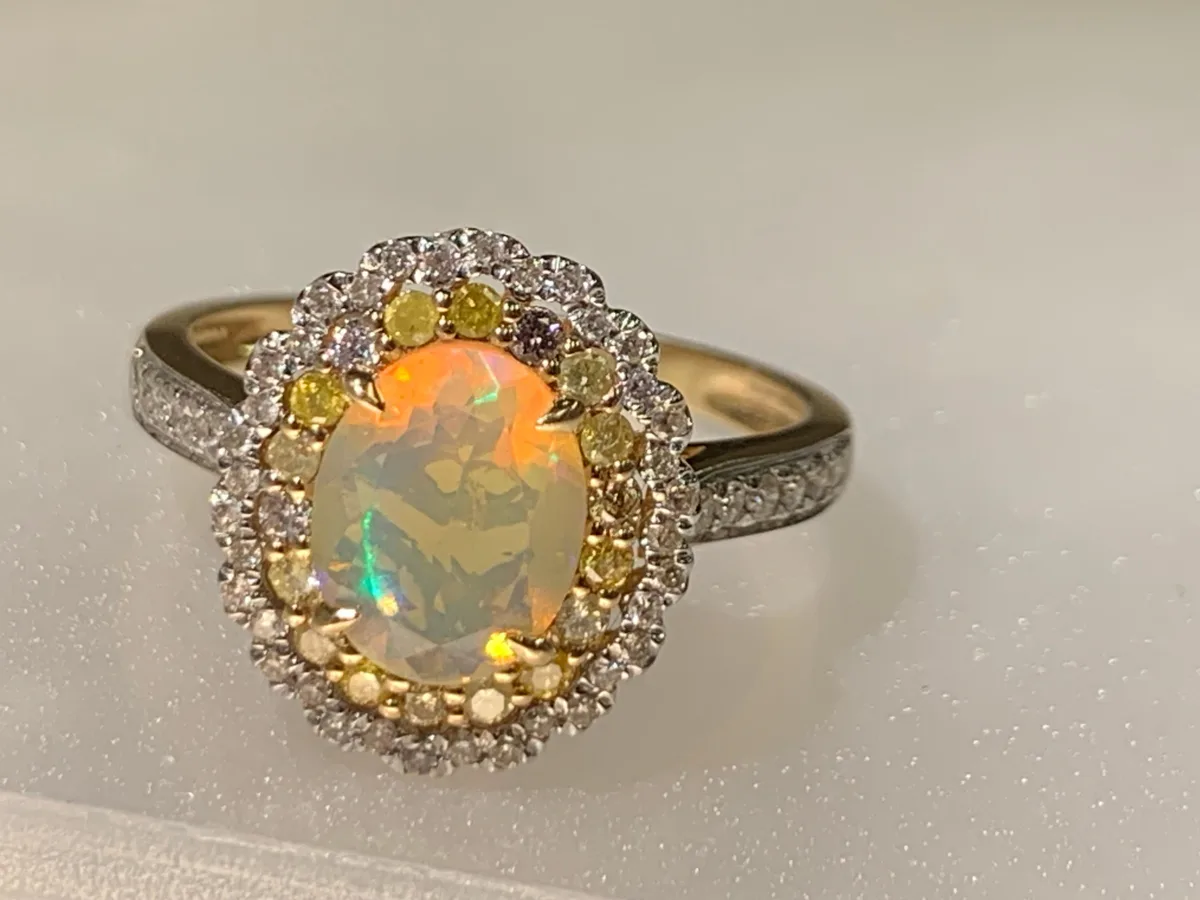
Image source: Bing (Web (fair-use with source credit))
Quick Answer
An opal ring turns yellow from water because it is porous. Ethiopian hydrophane opals absorb liquid like a sponge. Water fills the tiny spaces between the internal silica spheres.
This changes how light passes through the stone. The play of color fades and the stone looks yellow. Slow air drying will safely restore the original color.
Why Your Opal Turned Yellow in Water
Opals are composed of hydrated amorphous silica ($SiO_2 \cdot nH_2O$). Unlike crystalline gemstones like diamonds or sapphires, an opal contains an internal network of microscopic silica spheres stacked in neat grids. When light hits these spheres, it diffracts into flashes of rainbow colors, known as the play-of-color phenomenon.
Hydrophane opals have an open, porous structure full of microscopic voids. When you submerge the stone, water enters these pores via capillary action. Because water has a refractive index of roughly 1.33 and opal sits near 1.45, displacing the internal air changes how light moves through the gem.
Instead of bouncing and diffracting off the spheres to create bright flashes, the light passes straight through or scatters unevenly. This internal shift makes the body tone turn a muddy yellowish-brown, translucent, or dull gray. The good news is that the mineral itself has not changed.
It is simply waterlogged.
Identifying Your Stone: Ethiopian vs. Australian vs. Assembled Opals
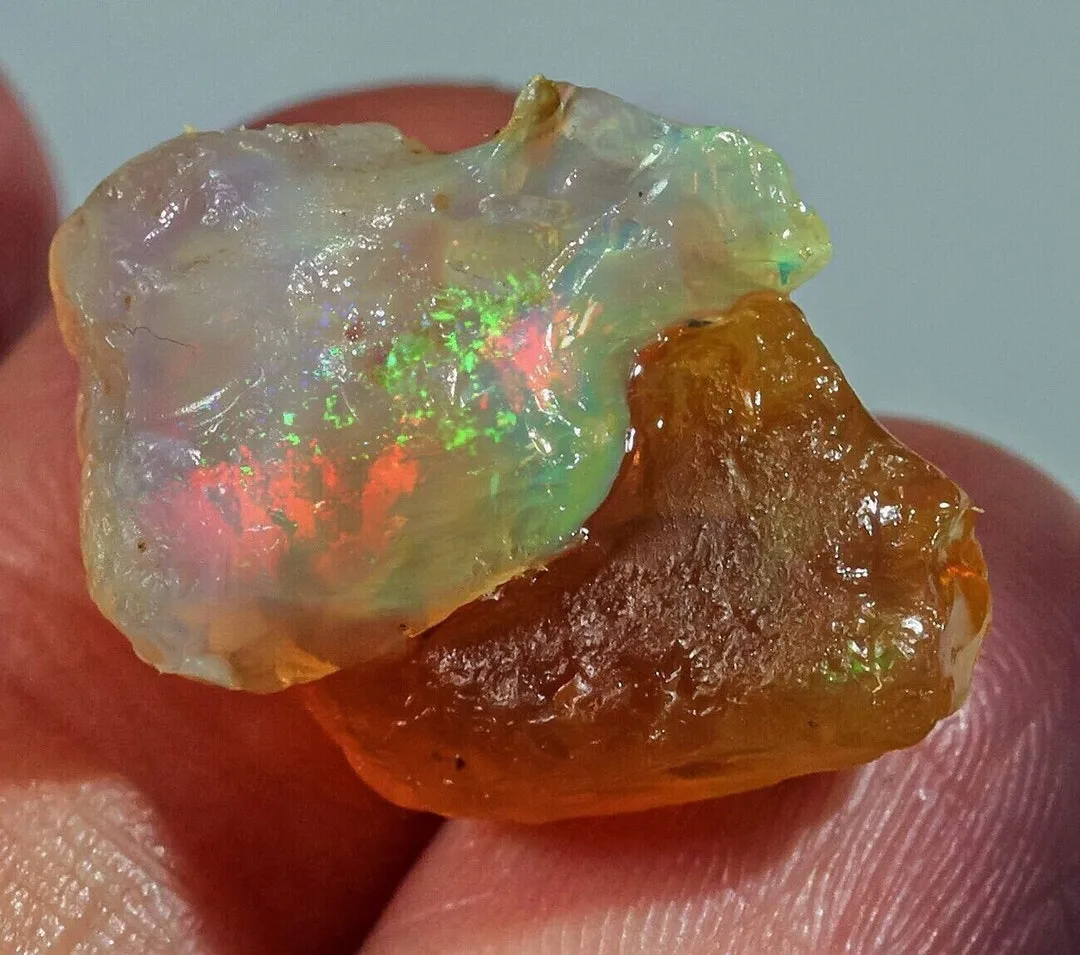
Image source: Bing (Web (fair-use with source credit))
Not all opals react to water in the same way. The geographical source and construction of your gem determine whether water is harmless, helpful, or destructive.
Ethiopian Welo Opal
Ethiopian opals, mined primarily from the Wollo Province, make up the majority of modern commercial jewelry. They are famous for their vivid neon patterns and accessible pricing, but nearly all of them are hydrophane. According to research published by the Gemological Institute of America, these stones can absorb up to 8 percent of their weight in liquid.
When soaked, they lose their fire and show a distinct yellowish cast, returning to normal once dry.
Australian Sedimentary Opal
Australian opals from regions like Coober Pedy or Lightning Ridge are non-porous sedimentary stones. Their internal silica structure is tightly packed, meaning they cannot absorb liquid. If an Australian opal turns yellow or dull after getting wet, the stone is not absorbing water.
Instead, the discoloration is usually caused by dirt or soap film building up beneath the ring setting.
Assembled Opals: Doublets and Triplets
Doublets and triplets are composite gemstones created by gluing a thin slice of opal to a dark backing, often topped with a quartz or glass dome. These stones should never be exposed to water. When soaked, moisture attacks the adhesive layer between the materials.
This causes the glue to fog up, turn yellow, or peel away entirely, causing permanent damage that air drying cannot fix.
| Opal Type | Water Absorption | Reaction to Water | Recovery Method |
|---|---|---|---|
| Ethiopian Welo | High (hydrophane) | Turns yellow, brown, or clear; loses fire | Controlled ambient drying |
| Australian Solid | None to negligible | No change to the stone itself | Clean surface with a cloth |
| Doublet / Triplet | Absorbs at glue seams | Cloudy glue layer, yellowing, delamination | Professional repair required |
Triage Decision Tree: Evaluating the Liquid Exposure
How you handle the ring depends entirely on what kind of liquid the stone absorbed. The drying process is safe for pure water, but contaminants require intervention before drying begins.
Scenario A: Clean Tap or Rainwater
If the stone only encountered pure drinking water or rain, you have nothing to worry about. The mineral absorbed pure moisture that will evaporate cleanly over time without leaving behind residue.
- Action: Do not rinse with chemicals. Proceed straight to ambient air drying.
Scenario B: Soapy Water, Shampoo, or Detergents
Washing hands, washing dishes, or showering exposes the stone to surfactants, fragrance compounds, and foaming agents. If this soapy liquid dries inside the gem, it leaves solid residues behind inside the nanopores. Those residues will permanently stain the opal a dull, milky yellow.
- Action: Submerge the ring in pure distilled water for 15 to 20 minutes to draw out and dilute the soap before drying.
Scenario C: Hand Lotions, Sanitizers, or Cooking Oils
Oils and alcohol-based gels are catastrophic for hydrophane opals. The dense fats and synthetic oils penetrate the pores and displace the water. Because oils do not evaporate at room temperature, the yellow discoloration and loss of fire become permanent unless chemically flushed by a professional lapidary.
- Action: Blot excess oil immediately with an untreated microfiber towel. Do not apply heat or rubbing alcohol. Consult a jeweler immediately.
Step-by-Step Safe Drying Protocol
If your ring absorbed water or mild soap, follow this controlled evaporation routine to bring the fire back without cracking the stone.
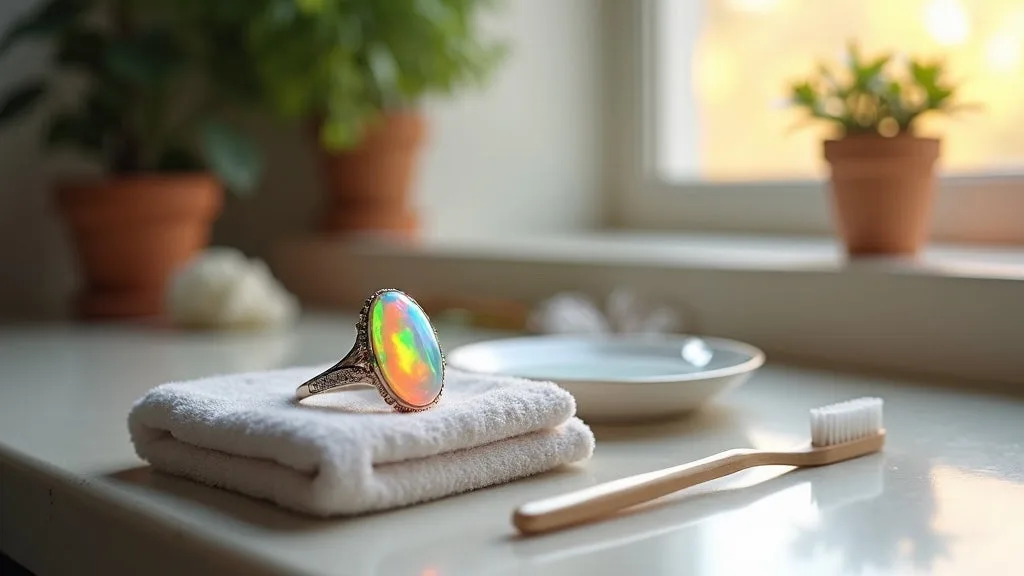
Image source: Web (Bing) / huntersfinejewellery.com (Web image (fair-use with source credit))
Step 1: Immediate Neutralization
If the water contained soap or chlorine, immerse the stone in a small dish of room-temperature distilled water for 10 minutes. This pulls trapped detergents out of the pores before they can settle into the silica matrix.
Step 2: Surface Blotting
Take a clean, lint-free microfiber cloth and gently press it against the stone and ring mounting. Do not rub, buff, or twist the gemstone. Let the cloth pull moisture off the surface and from around the prongs or bezel.
Step 3: Ambient, Dark Air-Drying
Place the ring on an untreated cloth in a dry, dark area at normal room temperature (68°F to 72°F / 20°C to 22°C). Keep it away from drafts, windows, and heating vents. The key is slow, uniform evaporation.
Depending on how deeply saturated the stone is, the waiting period takes anywhere from 72 hours to several weeks. As moisture leaves the porous structure, the play-of-color returns gradually, and the yellowish cast fades back to its original base tone.
Step 4: When (and When Not) to Use Desiccants
You can place the ring in an open cardboard container with a packet of commercial silica gel to help manage heavy humidity in the room. However, never pack an opal directly inside raw desiccant beads or dry white rice. Aggressively pulling moisture out of the stone too fast creates uneven surface tension, which leads directly to structural failure.
Dangerous Restoration Myths That Cause Crazing
When an opal turns yellow, many owners try to rush the drying process. Hastening this process is the fastest way to ruin a hydrophane gem permanently.
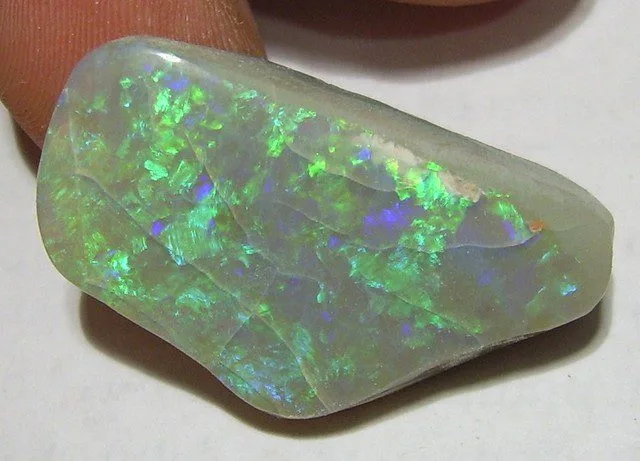
Image source: Bing (Web (fair-use with source credit))
Rapid moisture loss causes a fatal structural defect known as crazing. Crazing occurs when the outer shell of the opal shrinks and dries faster than the waterlogged core. The internal stress tears the stone apart, creating a dense web of micro-cracks that ruin both the brilliance and durability of the piece.
Avoid these common restoration mistakes:
- Hair dryers and ovens: Applying hot air or oven heat subjects the amorphous silica to rapid thermal shock. The expanding steam inside the nanopores shatters the gem from the inside out.
- Direct sunlight and UV exposure: Leaving a ring on a sunny windowsill heats the mounting and bakes the moisture out too fast. Sunlight also promotes uneven drying between the top of the stone and the hidden pavilion.
- Chemical dips and alcohol: Never clean a waterlogged opal with rubbing alcohol, acetone, or jewelry cleaning solutions. These harsh liquids replace the water inside the pores, leaving behind cloudy residues that never evaporate.
- Ultrasonic and steam machines: The high-frequency sound waves of an ultrasonic bath can crack a saturated opal, while commercial steam wands cause immediate thermal shock and crazing.
Long-Term Care, Prevention, and When to See a Lapidary
Living with a hydrophane opal means adopting simple daily habits. Because these gems sit between 5.5 and 6.5 on the Mohs hardness scale, they are physically soft as well as porous. Taking off your jewelry before washing your hands, swimming, applying lotions, or prepping food will keep the stone bright.
Store your ring in a fabric-lined jewelry box away from heat and direct sunlight. While Australian opals can tolerate occasional moisture, Ethiopian gems thrive best in stable, ambient room conditions. You do not need to store them in water or oil.
Storing porous stones in liquids will permanently alter their base color.
If your ring has been air-drying for six to eight weeks and remains dull yellow, the stone likely absorbed contaminants like perfume, cooking oils, or dish soap. Natural oils do not evaporate on their own. In this scenario, home remedies will not help, and aggressive cleaning will only risk fracturing the gem.
A professional lapidary or an experienced bench jeweler affiliated with groups like the American Gem Trade Association can assess the depth of the contamination. If the oils are confined near the surface, a light repolish might clear the haze. If the oil runs through the entire porous matrix, replacing the center stone is usually the most practical solution.
Frequently Asked Questions About Water-Damaged Opals
How long does it take for a yellowed opal to dry out?
Most hydrophane opals regain their original color within three to ten days of ambient air drying. Heavily soaked stones in humid climates can take up to four weeks. Never apply artificial heat to speed up the process.
Can tap water permanently ruin an opal ring?
Clean tap water rarely causes permanent harm to solid Ethiopian or Australian opals. The loss of fire and yellow shift will reverse once the moisture evaporates. Minerals or chlorine in hard tap water can leave residues over time, so distilled water is always safer.
Why did my opal turn clear instead of yellow?
Some Ethiopian crystal opals become completely transparent when saturated rather than yellow. The water fills the internal gaps, allowing light to travel straight through without scattering. As the moisture leaves, the milky base tone and colorful flashes return naturally.
Will putting my opal ring in rice help dry it faster?
Do not bury your opal in raw white rice. Rice pulls moisture out unevenly and creates dusty debris that can settle inside open pores. Uneven, rapid moisture extraction causes surface stress and leads directly to micro-cracking.
Can a jeweler fix an opal that stayed yellow?
A jeweler cannot reverse deep chemical or oil contamination inside a hydrophane opal. If the yellow tone comes from absorbed skin oils or hand lotion, repolishing only cleans the exterior. Deeply saturated gems usually require replacement.

Similar Posts