Lab Diamond vs Moissanite: The Rainbow Flash Truth
Founder & Fashion Creative Director at Julia Fashionista · CFDA Fashion Scholar, Certified Image Consultant (AICI) · 12+ years in editorial wardrobe styling, sustainable textile sourcing, and luxury capsule curation
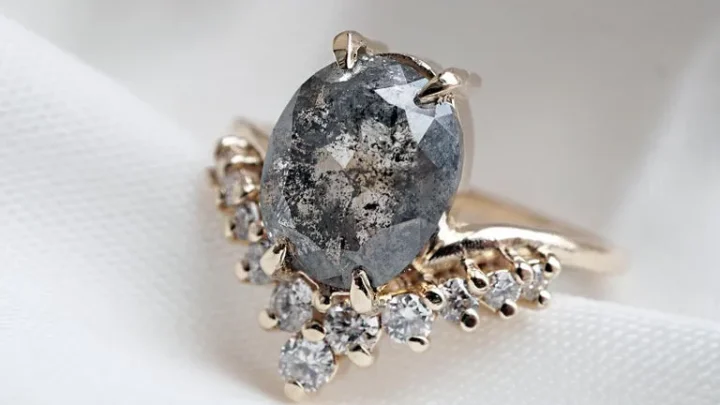
If you are shopping for an engagement ring, the lab grown diamond vs moissanite rainbow flash debate likely sits right at the center of your decision. Both stones offer incredible beauty and ethical appeal, but they handle light in completely different ways.
One stone produces crisp, balanced white light with subtle color glints, while the other creates an intense spectral display. As of 2026, standard optical measurements show moissanite delivers more than double the dispersion value of diamond, creating a vivid prism effect that is easy to spot once you know what to look for.
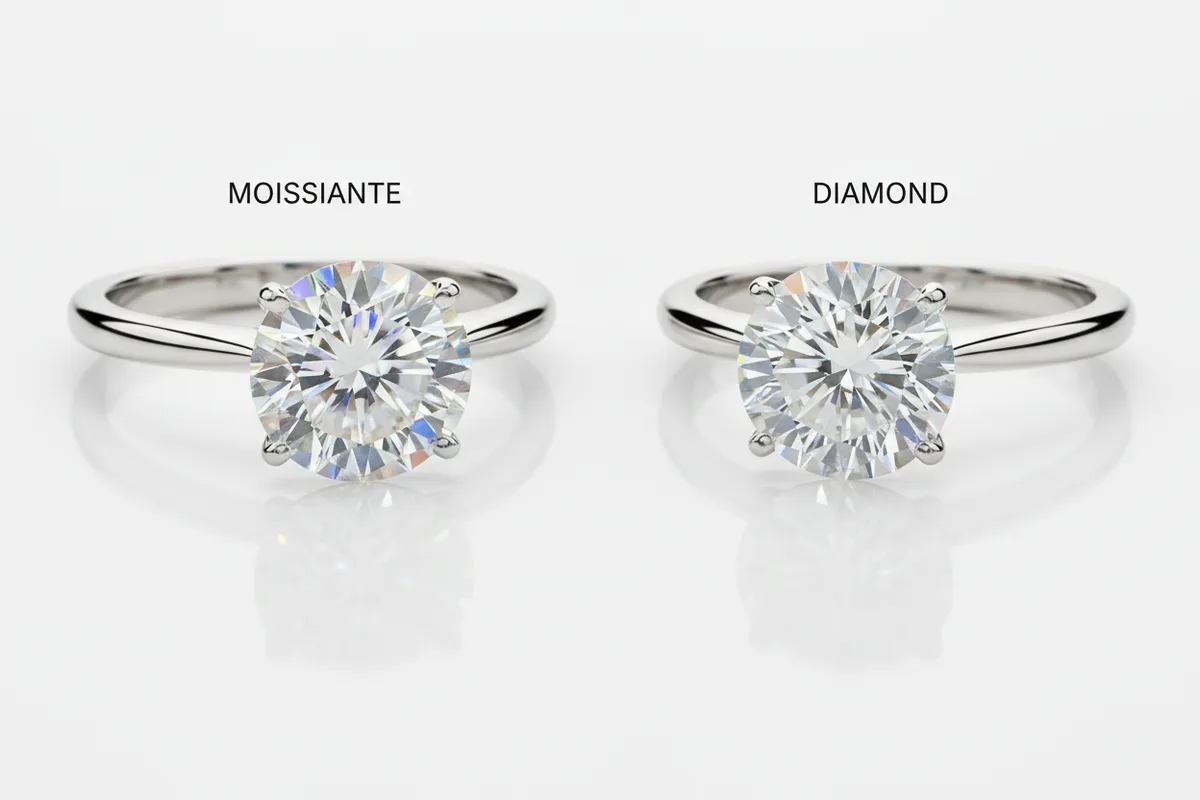
Image source: Bing (Web (fair-use with source credit))
Quick Answer
Moissanite shows much more rainbow flash than a lab-grown diamond. It has more than double the dispersion rate of diamond. Moissanite bends light twice, creating intense spectral colors.
Lab diamonds balance bright white light with subtle fire flashes. The diamond look is crisp, icy, and traditional.
The Rainbow Flash Phenomenon: Fire vs. Brilliance
To understand the difference between these two gems, you need to know how gemologists define sparkle. Sparkle is not just one single visual effect. It is a mix of three distinct optical behaviors: brilliance, fire, and scintillation.
Brilliance refers strictly to the white light return that reaches your eye. When light hits the surface facets and bounces back out through the table, that bright white flash is brilliance.
Fire is the proper term for rainbow flash. This occurs when white light enters the stone, slows down, and splits into spectral colors like red, orange, green, and violet.
Scintillation describes the alternating pattern of light and dark flashes you see when the stone moves.
A lab-grown diamond balances brilliance and fire evenly. You get a clean, bright white light return complemented by quick, needle-thin pops of color.
Moissanite prioritizes fire over subtle white light. It throws broad, saturated ribbons of vivid color across the entire room. In direct sunlight, this intense rainbow display creates what many call the disco ball effect.
It is flashy, bold, and impossible to miss.
The Science Behind the Sparkle: Dispersion and Refraction
The dramatic difference in rainbow flash comes down to crystal physics. Diamond consists of pure carbon arranged in an isometric cubic crystal system. Moissanite is silicon carbide, formed in a hexagonal crystal structure.
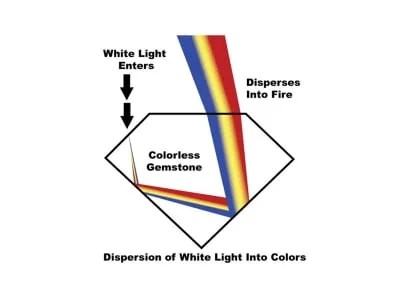
Image source: Bing (Web (fair-use with source credit))
These distinct atomic arrangements control two critical metrics: refractive index and dispersion.
Refractive index measures how much a gemstone bends light rays as they enter. Lab diamonds carry a refractive index of roughly 2.42. Moissanite measures significantly higher, sitting between 2.65 and 2.69.
A higher refractive index means light bends more sharply, giving moissanite immense raw sparkle.
Dispersion measures a stone's ability to separate white light into spectral wavelengths. Diamond has a dispersion rating of 0.044. Moissanite measures an astonishing 0.104, which is 2.36 times higher.
When light passes through moissanite, it breaks apart into wide color bands rather than tight, subtle points.
Another major factor is optical refraction type. Diamond is singly refractive, meaning light travels through the stone at uniform speed in all directions.
Moissanite is doubly refractive, also known as birefringent. When a light ray enters moissanite, it splits into two distinct rays that travel at different speeds. You can learn more about how optical materials bend light through standard indices compiled by the National Institute of Standards and Technology.
This internal splitting doubles the number of light rays bouncing back out, amplifying the rainbow flash.
Real-World Lighting: How Each Stone Actually Looks in Everyday Life
How these stones look depends heavily on the ambient lighting around you. A gem that looks understated in your living room can look like a laser show inside a supermarket.
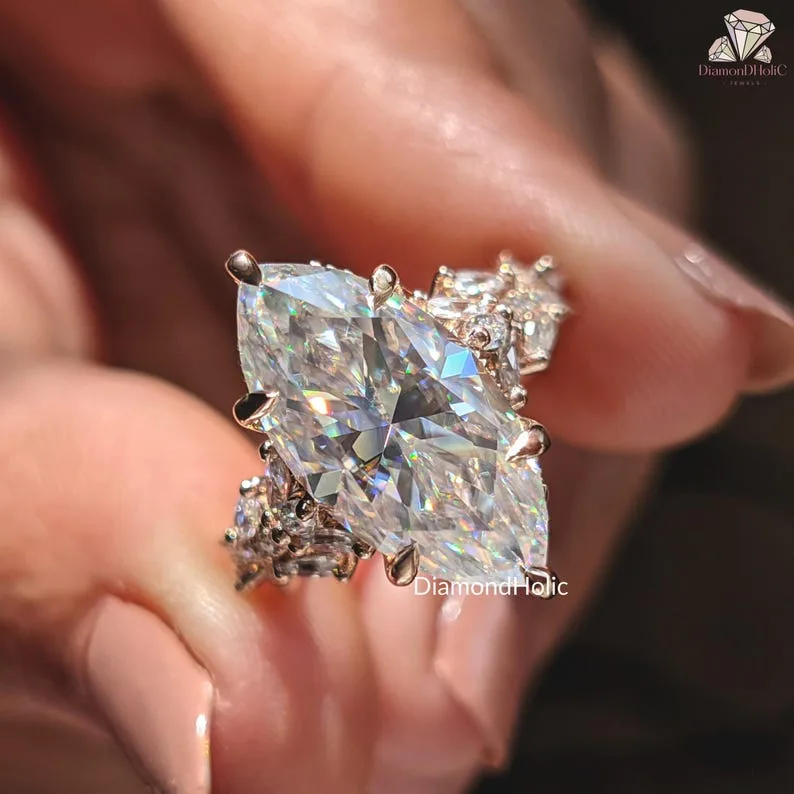
Image source: Bing (Web (fair-use with source credit))
Here is how each performs across everyday settings:
- Direct midday sunlight: Moissanite erupts into saturated rainbow sparks. Every facet throws red, blue, and yellow flashes. A lab diamond remains noticeably crisp, showing bright white flashes peppered with subtle color pops.
- Overcast outdoor light: Diffused gray skies reduce fire in both stones. A lab diamond looks clear, glassy, and bright white. Moissanite stays bright but its signature rainbow flashes tone down significantly.
- Commercial LED spotlights: Grocery stores and elevators feature harsh overhead LEDs. Moissanite displays its strongest disco ball effect here. Lab diamonds produce high scintillation with sharp, alternating black-and-white contrast.
- Warm indoor living rooms: Under standard incandescent table lamps, both stones soften. Lab diamonds look warm and deep. Moissanite displays gentle pastel flashes without overwhelming the eye.
- Candlelight and dim restaurants: Lab diamonds maintain incredible depth and facet definition. Moissanite picks up warm amber tones and continues throwing warm orange and red flashes.
If you love dramatic color, moissanite thrives in intense lighting. If you prefer a clean, icy look that stays consistent anywhere, a lab diamond delivers that stability.
Side-by-Side Optical Specs and Performance Differences
Comparing raw numbers helps explain why the human eye perceives these stones so differently. While both rank as premium, colorless gems, their physical specs diverge sharply.
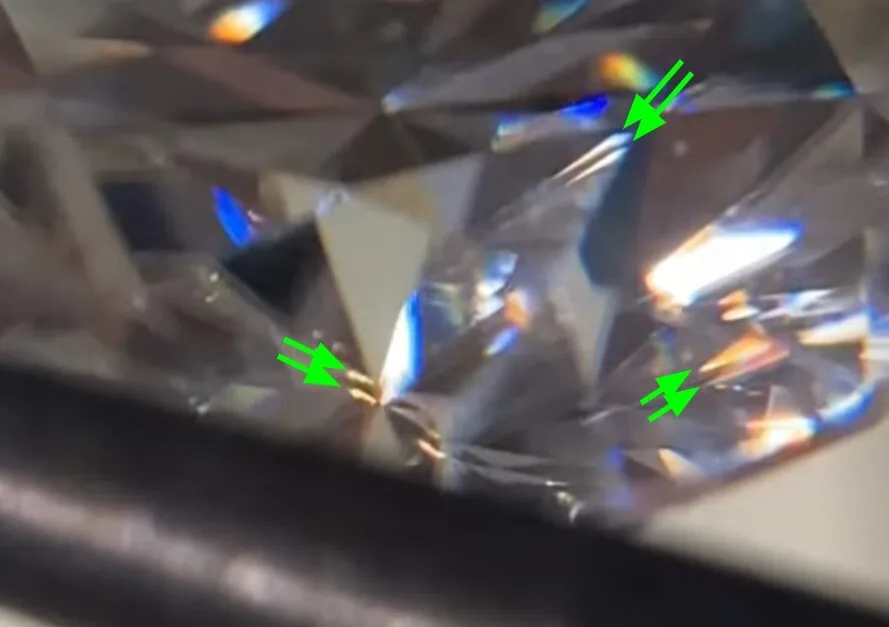
Image source: Bing (Web (fair-use with source credit))
| Optical / Physical Spec | Lab-Grown Diamond | Moissanite |
|---|---|---|
| Chemical Composition | Pure Carbon ($\text{C}$) | Silicon Carbide ($\text{SiC}$) |
| Crystal System | Isometric (Cubic) | Hexagonal |
| Refractive Index (RI) | 2.417 – 2.420 | 2.650 – 2.690 |
| Dispersion (Fire) | 0.044 | 0.104 |
| Light Refraction | Single Refraction | Double Refraction (Birefringent) |
| Birefringence Value | None (0.000) | 0.043 |
| Mohs Hardness Scale | 10 | 9.25 |
| Primary Visual Trait | Crisp, balanced brilliance | High-intensity rainbow fire |
Double refraction creates a visual trait called facet doubling. If you inspect moissanite from an angle under 10x magnification, the facet junctions on the opposite side of the stone appear duplicated.
In smaller stones, facet doubling simply creates extra sparkle. In gems over three carats, however, it can occasionally cause a faintly hazy look under direct sun. Diamond never shows facet doubling because its single refraction keeps facet lines razor-sharp at every angle.
Which Stone Matches Your Style and Daily Wear Habits?
Choosing between these stones comes down to aesthetic preference, budget, and lifestyle expectations. Neither option is objectively better, but one will match your daily routine better than the other.
A lab-grown diamond is ideal if you want classic diamond aesthetics. It offers the exact look people associate with heirloom fine jewelry: sharp contrast, cold white brilliance, and subtle fire. It is also the hardest mineral on earth at a perfect 10 on the Mohs scale, making it practically scratch-proof against everyday abrasives.
Moissanite is ideal if you value maximum sparkle and distinct character. It is not a fake diamond; it is an entirely unique gemstone with its own optical identity. If you find traditional diamonds a bit flat or cold, moissanite offers fiery, eye-catching color flashes.
At 9.25 on the Mohs scale, moissanite is harder than sapphires or rubies. It easily handles decades of uninterrupted daily wear without chipping or scratching. It also costs a fraction of the price of a lab diamond, allowing you to maximize carat weight without overspending.
Common Misconceptions and Buying Traps to Avoid
The biggest mistake shoppers make is buying moissanite and expecting it to pass as a diamond in every setting. Because of that double refraction and high dispersion, anyone familiar with jewelry will spot the difference in bright sunlight. Treat moissanite as its own gorgeous gem, not a diamond imposter.
Another trap involves stone sizing. In larger sizes, especially above two carats, moissanite's disco-ball flash becomes intensely obvious. If you want a more subtle, diamond-like appearance from moissanite, aggregate jeweler reviews suggest staying between 1.0 and 1.5 carats.
Cut shape also alters the optical effect dramatically. Round brilliant cuts maximize fire in both stones. If you want to tone down moissanite's rainbow flashes, choose a step cut like an emerald or Asscher cut.
Step cuts feature long, rectangular facets that produce quiet white flashes rather than fiery rainbow bursts.
Watch out for the notorious moissanite oil slick. Over months of wear, skin oils and hard water deposits can form a hazy, rainbow-tinted film across the surface facets.
This film is not permanent damage to the crystal. You can clean it easily with warm water, mild dish soap, and a soft toothbrush. A specialized silver polishing cloth or jewelry cleaning paste also strips the residue off instantly.
Diamonds attract grease just as easily, but oil buildup dulls a diamond's shine rather than creating that distinct oily surface sheen.
Frequently Asked Questions About Diamond and Moissanite Sparkle
Can you tell the difference between moissanite and lab diamond with the naked eye?
Yes, you can tell them apart easily under direct sunlight or spot lighting. Moissanite throws vivid, multi-colored rainbow flashes across wide angles. A lab diamond shows much more crisp, white brilliance with subtle, sharp flashes of spectral color.
Does moissanite look fake or like costume jewelry?
Moissanite looks fake only when buyers choose massive carat sizes expecting diamond optical behavior. In direct sun, large stones create an intense prism display that looks completely unlike diamond light performance. In modest sizes, it looks like a high-end, exceptionally brilliant fine gemstone.
Do lab diamonds have rainbow sparkle at all?
Yes, lab diamonds produce genuine rainbow fire. Because diamond dispersion sits at 0.044, those spectral colors appear as delicate, pinpoint flashes. The rainbow effect in a diamond is balanced, accenting the primary white light return rather than overwhelming it.
Why does moissanite sparkle more than a lab diamond?
Moissanite sparkles more because of its higher refractive index and double refraction. It bends light more sharply and splits each incoming light beam into two separate paths. Combined with a dispersion rating over twice that of diamond, it maximizes fiery light return.
Does moissanite get cloudy over time?
No, moissanite never turns cloudy internally. The crystal structure of silicon carbide is completely stable and impervious to heat and household chemicals. Any perceived cloudiness is almost always an external layer of surface grime or oil buildup that washes off with basic cleaning.
Final Verdict: Choosing the Right Flash for Your Ring
If you want the classic, icy sparkle of traditional bridal jewelry, choose a lab-grown diamond. You get authentic diamond physics, unmatched durability, and a clean balance of white light brilliance and subtle fire. It looks timeless under every lighting condition, from moody dinner spots to harsh grocery store LEDs.
If you love show-stopping sparkle, saturated rainbow fire, and maximum value per carat, moissanite is a stellar pick. It delivers incredible optical performance that stands out in any crowd.
To explore official consumer guidance on synthetic and alternative gems, review consumer resources published by the Federal Trade Commission.
Both stones offer ethical sourcing, outstanding everyday toughness, and stunning visual appeal. The right choice simply depends on which light show you want to see on your finger every day.

Similar Posts