Love Bracelet Sizing: Should It Fit Tight or Loose?
Founder & Fashion Creative Director at Julia Fashionista · CFDA Fashion Scholar, Certified Image Consultant (AICI) · 12+ years in editorial wardrobe styling, sustainable textile sourcing, and luxury capsule curation
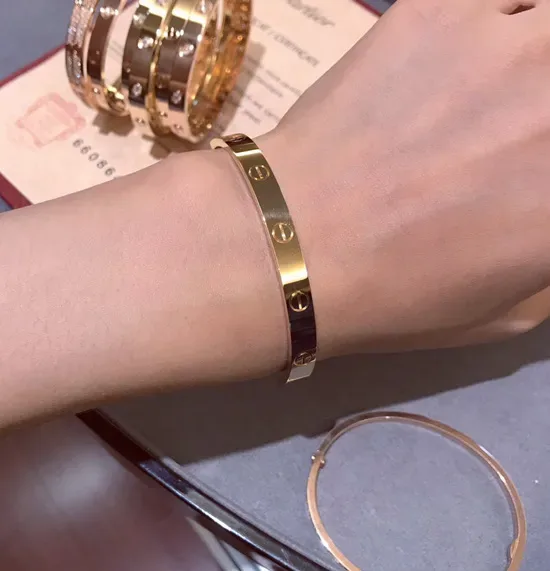
Image source: Bing (Web (fair-use with source credit))
Choosing the right fit for an iconic rigid bangle can feel like a high-stakes gamble. When evaluating Love bracelet sizing tight vs loose, you need to understand that this piece does not sit like a chain bracelet. It is a solid oval of 18k gold designed to stay on your arm around the clock.
A mistake here cannot be resolved with a quick jeweler trip. Resizing a solid screw-locking bangle requires invasive alterations that compromise the mechanical integrity of the screws and lower the resale value. Official guidelines from Cartier provide a baseline, but daily comfort hinges on your bone structure, climate, and daily habits.
Quick Answer
Love bracelet sizing tight vs loose comes down to wrist clearance. A tight fit adds 1 cm to your wrist size. A loose fit adds 2 cm.
Choose tight if you prefer your jewelry stationary. Choose loose if your wrists swell or you type all day.
The High-Stakes Fit: Why Getting Cartier Love Sizing Right Matters
Traditional link bracelets give you plenty of leeway. If a link bracelet is slightly small, a jeweler can add an extra link in ten minutes. If it is too big, taking a link out costs very little.
The Cartier Love Bracelet, created by designer Aldo Cipullo in 1969, does not work that way.
This piece is engineered as two rigid, C-shaped halves. They lock together with precision screws to form a seamless, structural oval. Because of that design, standard resizing methods do not apply.
Jewelers cannot stretch the gold without distorting the internal circumference. Cutting into the metal to remove material ruins the alignment of the screw motifs.
Getting the size right before the screws are tightened is your only safe path. The bracelet also carries significant physical weight. A classic model weighs between 30 and 38 grams of solid 18k gold, depending on the size.
If that weight sits too tightly against your wrist bone, it can cause chronic bruising and skin pinching. If it sits too loosely, the heavy metal will slide aggressively up and down your arm. You need a fit that balances aesthetics with long-term wearability.
Cartier’s Golden Rule: Breaking Down the +1 cm vs. +2 cm Formula
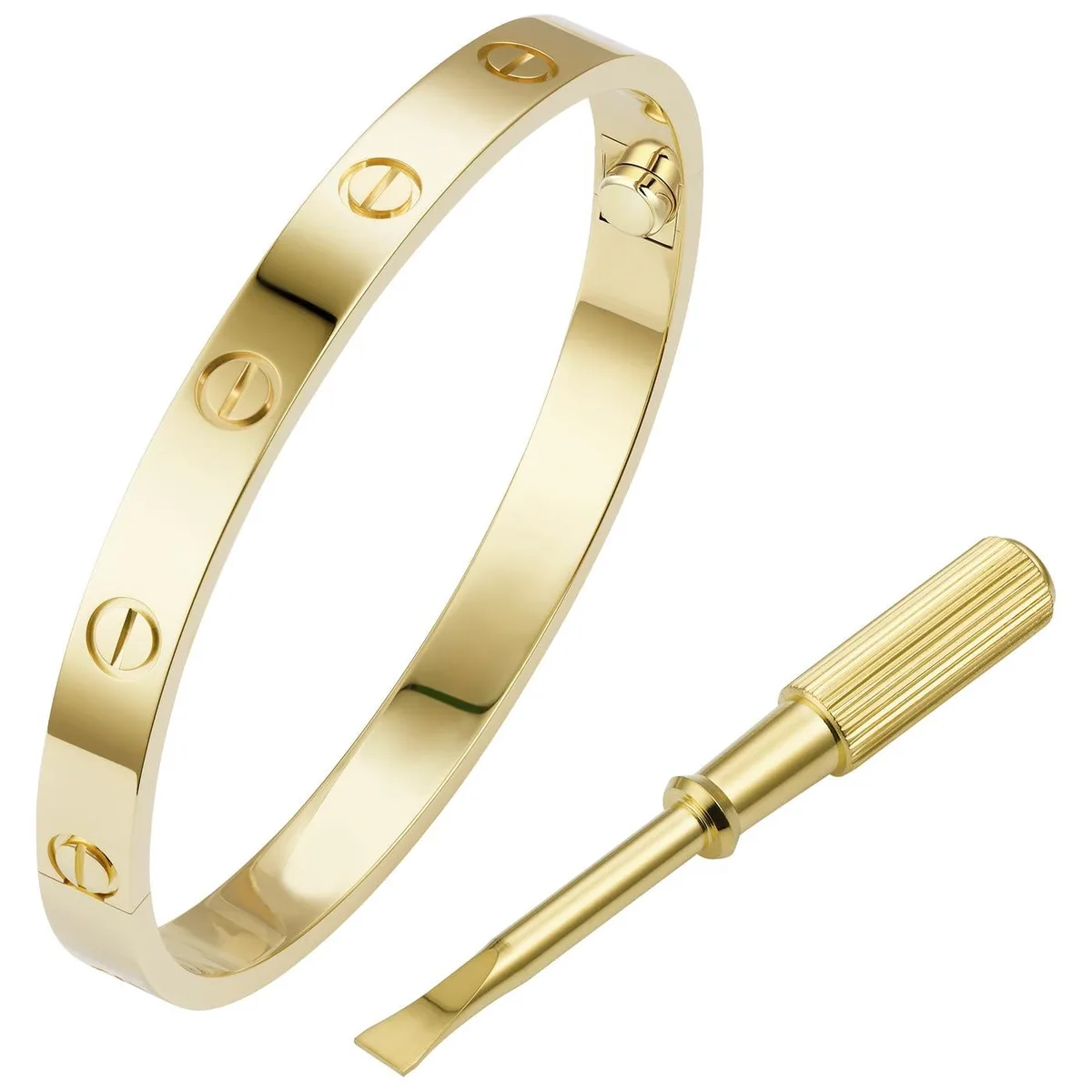
Image source: Bing (Web (fair-use with source credit))
Cartier uses a straightforward formula for the Love collection. First, measure your wrist tightly with a seamstress tape directly over the skin. Then, add a specific buffer based on your fit preference.
- Tight (Snug) Fit: Add 1 cm to your exact wrist measurement.
- Loose Fit: Add 2 cm to your exact wrist measurement.
The bracelet is sold in full centimeter sizes ranging from size 15 to size 21. If your wrist measures 15.2 cm, the formula gives you two standard options. Adding 1 cm points you to 16.2 cm (which rounds to a size 16 for a snug fit).
Adding 2 cm points you to 17.2 cm (which rounds to a size 17 for a loose drape).
The table below breaks down the baseline recommendations according to wrist dimensions:
| Bare Wrist Measurement | Recommended Size (Snug / +1 cm) | Recommended Size (Loose / +2 cm) | Radial Clearance |
|---|---|---|---|
| 14.0 cm – 14.5 cm | Size 15 | Size 16 | 5 mm – 15 mm |
| 15.0 cm – 15.5 cm | Size 16 | Size 17 | 5 mm – 15 mm |
| 16.0 cm – 16.5 cm | Size 17 | Size 18 | 5 mm – 15 mm |
| 17.0 cm – 17.5 cm | Size 18 | Size 19 | 5 mm – 15 mm |
| 18.0 cm – 18.5 cm | Size 19 | Size 20 | 5 mm – 15 mm |
This formula offers a helpful starting point, but it assumes your wrist has average proportions. It treats every wrist as an identical cylinder, which brings us to the biggest factor buyers overlook: wrist shape.
Wrist Anatomy and Geometry: Why Circumference Is Only Half the Story
A tape measure gives you an accurate one-dimensional length, but your wrist is a three-dimensional surface. The Cartier Love Bracelet is explicitly oval, not round. How that oval interacts with your skeletal profile will decide whether the bracelet feels comfortable.
Flat and Wide Wrists vs. Round Wrists
People with broad, flat wrists have an anatomy that naturally mirrors the bracelet's oval shape. If you have a flat wrist, the bangle will sit comfortably flush against your skin. You can easily wear a snug fit (+1 cm) without feeling restricted.
Round, cylindrical wrists do not share the bracelet's contour. A round wrist presses against the sides of the oval frame. That friction causes the bracelet to bind against your skin.
If you have round wrists, you almost always need the +2 cm loose fit to allow the bangle to rest naturally without pinching.
The Ulnar Head (Wrist Bone)
The ulnar head is the bony bump on the pinky-finger side of your wrist joint. Some people have a flat ulnar bone that barely protrudes. Others have a prominent, sharp wrist bone.
A rigid gold bangle cannot flex over that bone. If you choose a tight fit over a prominent ulnar bone, the metal will rub directly over the periosteum every time you move your hand.
That continuous friction leads to tenderness, redness, and bruising. If your ulnar bone stands out prominently, lean toward the loose fit (+2 cm). The extra room lets the bangle slide past the joint rather than digging into it.
The Snug Fit (+1 cm): Pros, Cons, and Daily Realities
A snug fit keeps the bracelet positioned close to the base of your hand with minimal sliding. The bangle stays stationary, typically moving no more than an inch up or down your forearm.
The Advantages of Going Snug
A tight fit keeps the bracelet facing upward. The screw motifs stay visible on top of your wrist instead of rolling underneath.
It also stays neatly tucked under dress shirts and jacket cuffs. If you wear an analog watch, a snug fit keeps the bracelet locked in place behind the case. That prevents the bangle from sliding forward and scratching against the watch bezel.
Scratching against other jewelry is also reduced. Because the bracelet cannot slide around, it develops fewer accidental dings against daily objects.
The Drawbacks to Consider
Your body changes throughout the day. In warm weather or during workouts, your wrist tissues naturally retain fluid.
Under hot conditions, a +1 cm fit can become uncomfortably tight. The rigid metal leaves deep red indentations in the skin.
It also traps moisture after showers or hand-washing. Soap scum and water held tight against the skin can trigger contact dermatitis. If you sit at a desk, a tight bracelet sits right on your wrist tendons, making computer keyboard use painful.
The Loose Fit (+2 cm): Pros, Cons, and Daily Realities
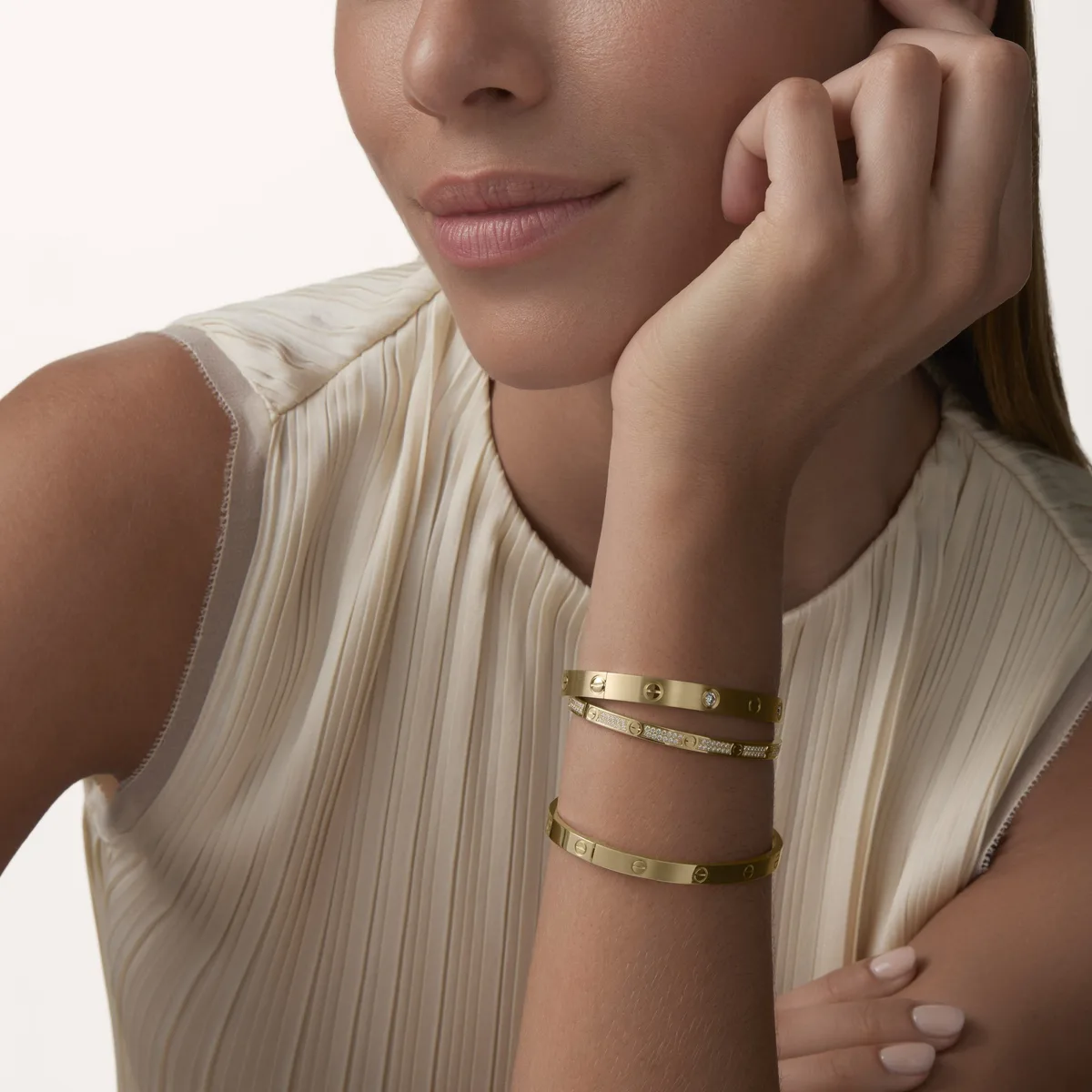
Image source: Bing (Web (fair-use with source credit))
A loose fit lets the bracelet move naturally along your arm. It drapes lower on the hand when your arm rests at your side and slides a few inches up the forearm when you raise your hand.
The Advantages of Going Loose
Comfort is the primary benefit of the +2 cm sizing. As of 2026, daily-wear jewelry trends strongly favor relaxed ergonomics over constricting fits.
A loose bangle accommodates natural wrist swelling without cutting off circulation. In hot, humid climates, the air circulation under the bracelet prevents sweat accumulation.
Desk work is also much easier. When typing, you can push the bracelet two to three inches up your forearm so it sits out of the way, keeping the metal off your desk surface.
The Drawbacks to Consider
The extra slack means constant movement. A loose Love bracelet will spin freely around your wrist, meaning the screw motifs will often face downward.
It is also more prone to surface scratches. When you walk, the loose metal slides forward, striking against hard surfaces, door handles, and countertops.
If you stack multiple bracelets, a loose fit allows the pieces to ride up and collide with each other. This constant metal-on-metal contact creates premature wear and superficial scuffing across the polished gold.
Side-by-Side Comparison: Tight vs. Loose Across Real-World Scenarios
Picking between a snug and loose fit depends on how you spend your day. A fit that looks stunning in a boutique mirror might feel frustrating during a ten-hour shift at a laptop.
Daily micro-movements dictate long-term satisfaction. The following breakdown shows how both sizing philosophies perform across real-life situations:
| Scenario / Factor | Tight Fit (+1 cm) | Loose Fit (+2 cm) |
|---|---|---|
| Desk Work and Typing | Rests directly under tendons. Can press uncomfortably against laptop edges. | Slides comfortably up the forearm. Keeps the gold away from desk contact. |
| Sleeping in the Bracelet | Stays firmly in place. Does not pinch when you tuck hands under pillows. | Can slide down toward the hand. Occasionally pinches soft skin during turns. |
| Stacking with Other Pieces | Anchors the base. Keeps adjacent watches or cuffs from twisting over it. | Moves freely. Clanks against neighboring bangles and accelerates scuffing. |
| Warm Weather & Flights | Risks skin constriction. May leave deep indentations during fluid retention. | Provides ample expansion room. Remains comfortable when limbs swell. |
| Screw Mechanism Stress | Higher lateral tension against screws during heavy wrist flexion. | Lower direct tension on locking threads, but higher rotational surface wear. |
If you type for hours every day, the loose fit wins on sheer ergonomics. You can simply push the bangle two inches up your arm to clear the desk surface entirely.
If you stack multiple luxury pieces, the snug fit is vastly superior. It prevents the Love bracelet from sliding over a watch bezel or tangling with a delicate tennis chain.
How to Measure Your Wrist Accurately at Home
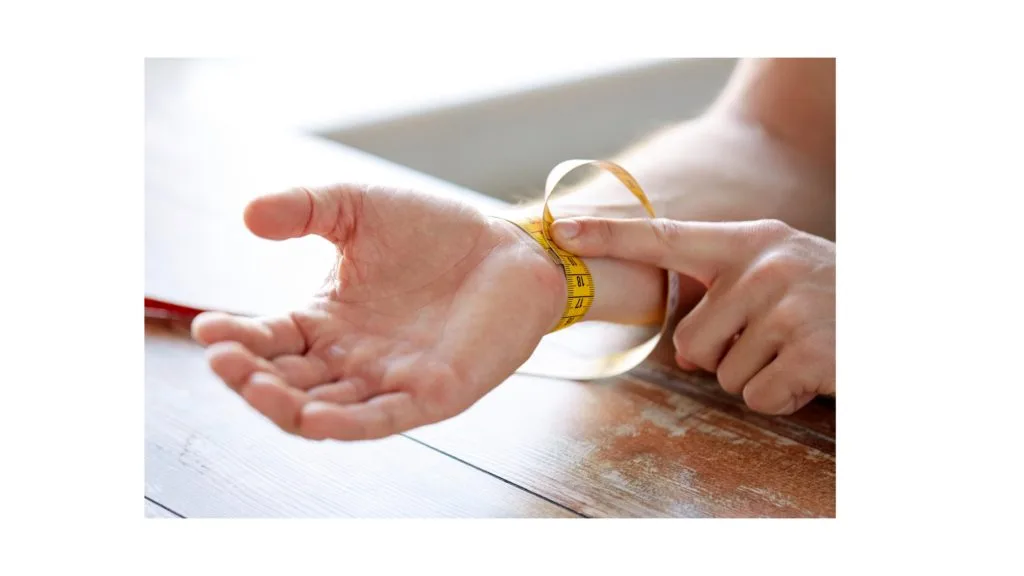
Image source: Bing (Web (fair-use with source credit))
An accurate measurement prevents costly sizing mistakes. You do not need professional jeweler equipment to find your baseline circumference. You only need a flexible tailor's tape or a simple strip of paper.
Follow these four steps to find your exact measurement:
- Locate your measurement zone: Find the spot directly behind your ulnar wrist bone, toward your elbow. This is where the bracelet naturally rests most of the day.
- Wrap the measuring tool: Wrap a flexible cloth tape measure smoothly around that exact area. If you use paper, wrap a clean strip around the wrist and mark the overlap with a fine pencil.
- Pull flat with zero slack: Do not pull the tape so tight that it pinches your skin. Do not leave any loose gap either. Read the number to the nearest millimeter.
- Repeat the measurement over the bone: Wrap the tape directly over the widest part of your ulnar bone. If that second number is more than 1 cm larger than your forearm measurement, you must size up to avoid joint pain.
Per guidelines from the Gemological Institute of America on fine metal care, rigid bangles require measured clearance to avoid mechanical strain on lock points. Never use a metal builder tape measure for this process, as stiff metal creates an inaccurate, oversized reading.
Frequently Asked Questions About Cartier Love Sizing
Can Cartier resize a Love bracelet if I pick the wrong size?
No, Cartier will not resize a classic Love bracelet. The rigid oval shape and perimeter screw motifs prevent cutting or stretching without ruining the design. If you purchase directly from an official boutique, you can exchange an unworn bracelet within their standard return window.
Should I choose tight or loose if I am between sizes?
Always size up if your wrist measurement falls on a half-centimeter mark. If your wrist measures 16.5 cm, choosing size 17 (+0.5 cm) leaves almost no room for natural swelling. Choosing size 18 (+1.5 cm) provides a comfortable middle ground that prevents painful pressure marks.
Does the Small Love Bracelet fit the same as the Classic?
The Small Love Bracelet feels slightly roomier than the Classic version in the same size. Because the Small model is only 3.65 mm wide compared to the 6.1 mm Classic, it has less surface area friction against your skin. You can choose a snugger size with the thin model.
Will a loose Love bracelet fall off over my hand?
A loose Love bracelet will not fall off your hand if you follow the +2 cm rule. Even with the extra two centimeters of clearance, the rigid oval opening remains too narrow to pass over the broad knuckles of your thumb and palm.
How much do wrists swell throughout the day?
Wrists typically fluctuate between 0.5 cm and 1 cm in circumference throughout an average day. Factors like summer humidity, high sodium meals, exercise, and long-haul flights cause temporary water retention. A tight +1 cm fit will feel noticeably restrictive during these swelling cycles.

Similar Posts